













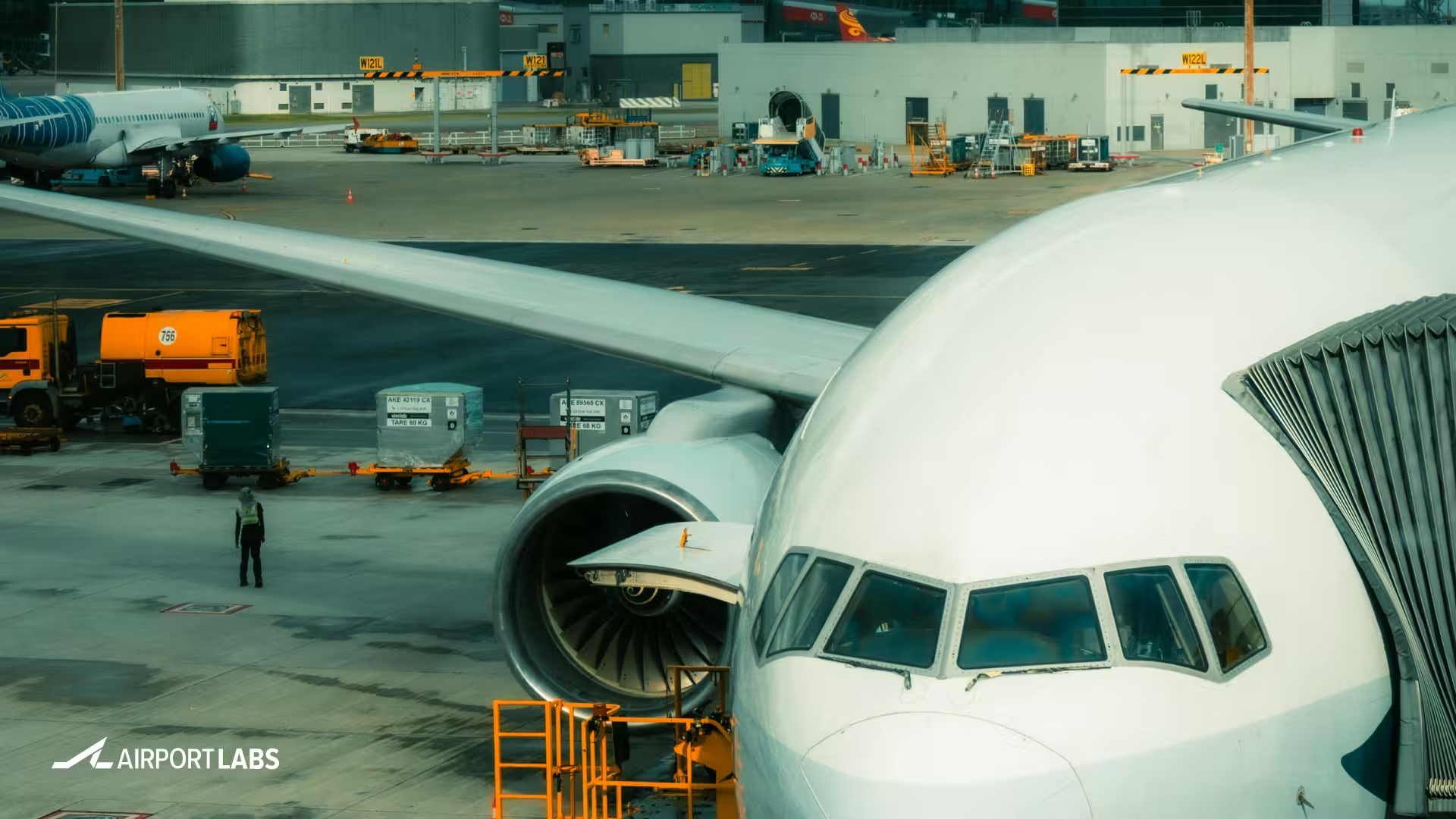
In airports worldwide, an invisible but measurable metric dominates the day: the time spent manually mediating data. This is the Swivel Chair Penalty: the visible symptom of fragmented core systems.
Defining the Cost of System Fragmentation
A high-value operations coordinator is forced to swivel between the Airport Operational Database (AODB) console to verify resource status in the Resource Management System (RMS), confirm the public message on the Flight Information Display System (FIDS), and initiate manual communication to the Billing team. This constant, repetitive cycle of human verification and translation is where operational friction is born.
The core issue is architectural. When AODB, RMS, FIDS, and Billing are implemented as independent, functional silos - a common legacy practice - the essential, high-speed work of connecting them falls to your most highly-trained human capital.
The Cascade Effect: Latency and Operational Risk
This time spent on data mediation and consolidation is a strategic drain on throughput. Latency is introduced the moment a human is required to translate and manually input verified truth across platforms.
Crucially, this latency immediately impacts the FIDS. If an AODB update reaches the FIDS platform late, the airport presents a contradictory message to passengers and staff. This is a visible breakdown of operational quality and a source of confusion for ground teams and passengers alike. As air traffic complexity grows, this reliance on manual data integration exponentially increases the risk of error, compromising operational efficiency and compliance.
Strategic Imperative: Synchronisation and Latent Capacity
The ultimate goal is not to optimise one system, but to ensure that all core systems seamlessly flow data like one unified, autonomous engine. This requires a move beyond simple data storage toward true system synchronisation.
Industry guides increasingly stress the need for a unified system to achieve a common operational understanding. For instance, the ACI Europe Guide on Airport Operations Centres (APOCs) provides frameworks advocating for the centralisation of decision-making and data visibility for optimal resilience.
Eliminating manual data mediation is the key to unlocking latent capacity. When the AODB feeds the RMS and FIDS instantly, you remove the latency that forces buffers. This real-time data exchange is foundational to global initiatives like Airport Collaborative Decision Making (A-CDM), which relies on accurate and timely data sharing to optimise capacity and predictability.
The AirportLabs POV: Eliminating the Latency Point
At AirportLabs, we recognise that true airport operations management requires solving the problem at the architectural level. We believe that operational risk resides in the handoff between systems rather than in the performance of an individual tool.
To illustrate how this works in practice, let’s follow the journey of a single data point: a Gate Assignment.
The Integrated Data Journey: From Decision to Revenue
- Planning (Allegra RMS): A solver, or occasionally an operator, assigns Flight A123 to Gate B12 by evaluating multiple operational constraints and preferences—such as aircraft size, airline, origin, and turnaround time—ensuring efficient gate use and smooth operations.
- Validation (SkyCore AODB): The RMS pushes this update to the AODB, which validates it against the flight schedule. The AODB now has this record as the single source of truth.
- Communication (VisionAir FIDS): The FIDS is subscribed to the AODB. The moment the record changes, the FIDS pulls the new Gate ID and updates passenger screens instantly.
- Revenue (AirportLabs Billing): Because the Billing system is part of this same loop, the gate usage is logged for the airline’s invoice the second the flight departs.
This same automated flow applies to every critical update, from Estimated Time of Arrival (ETA) triggered by radar data to Baggage Carousel IDs and Flight Status changes. There is no manual re-entry, no "swivelling" between screens, and no room for doubt.
Bridging the Gap to Revenue: As airports evolve into commercial enterprises, maximising financial performance requires this level of granular, verifiable data. This aligns with guidance from organisations like ACI, which emphasize the strategic role of integrated data in maximising non-aeronautical revenue. When your financial data is a direct reflection of your operations, you eliminate the friction of post-event reconciliation.
Our Decisive Stance
At AirportLabs, we replace fragmented silos with a unified platform that eliminates the handoff by design. By building the connection directly into the architecture, we ensure that data is never moved or translated, but it is instead simultaneously available across all systems and platforms. This infrastructure provides the foundation for a high-speed communication tunnel, creating a permanent, 100% up-and-running flow of information that removes the need for manual mediation.

By ensuring your systems are permanently in sync through this dedicated channel, we remove the human latency point entirely. This allows your teams to stop acting as data reconcilers and start focusing on high-value strategy and safety, turning operational friction into engineered efficiency.
Stop Paying the Penalty and Start Reclaiming Your Capacity.
Contact the AirportLabs team today for a consultation on how our integrated core suite can eliminate operational friction and elevate your team’s performance: https://www.airportlabs.com/other/get-in-touch
.png)