











Next time you land, stay by the window for a moment. Before the seatbelt sign goes off, a few people in high-visibility vests are already waiting at the edge of the stand. They’ve been following your flight on their screens for a while, and they know exactly what to do as soon as the engines stop.
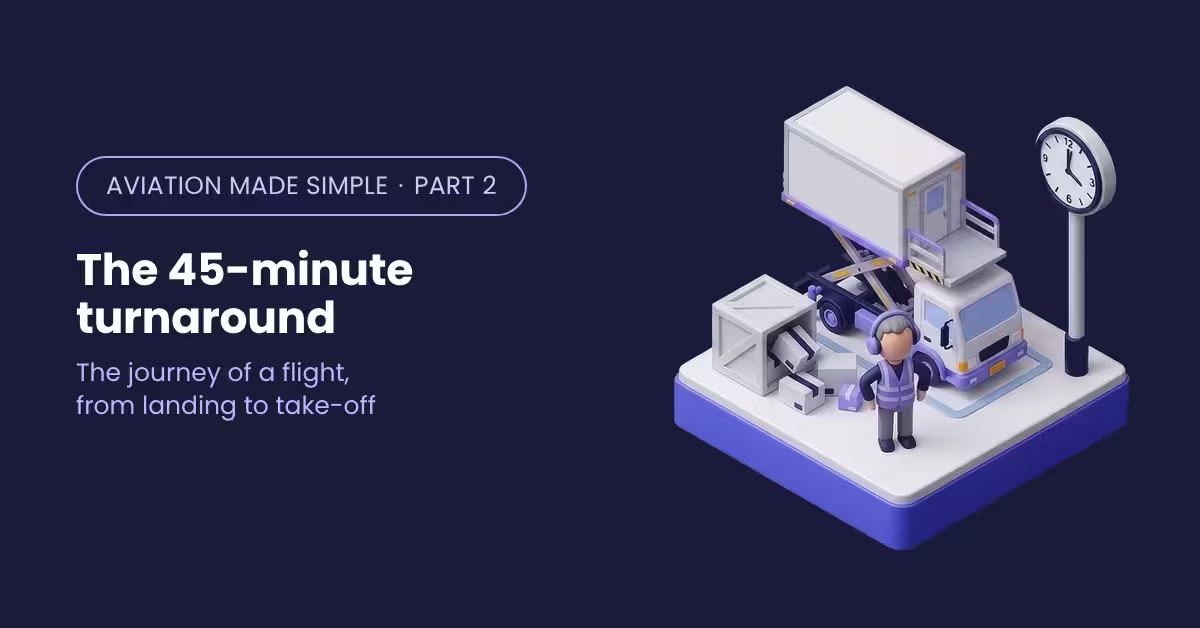
For a typical short-haul flight in Europe, they have around 45 minutes. In that time, the aircraft has to be emptied, cleaned, refuelled, restocked and filled again with new passengers and their bags. The industry calls it the turnaround. For the people on the apron, it’s simply the job, done many times a day, in sun, rain and wind.
In this second episode of Aviation Made Simple, we stay next to the aircraft and meet them.
The first person to greet your plane
Often, it’s a marshaller, the person holding two bright wands who guides the pilots into position. At some stands, a visual docking guidance system helps pilots line up the aircraft and stop in the right place.
The engines go quiet, the red light on the aircraft stops flashing, and that’s the signal that it’s safe to approach. Someone pushes chocks against the wheels, someone else sets out cones around the wings and engines. The aircraft is now in-block, and the clock starts.
One person keeps the whole picture
Around every turnaround, there’s usually one person keeping an eye on everything: the turnaround coordinator. They don’t load the bags or drive the fuel truck. Their job is to know, at any moment, what’s done, what’s late and what comes next, and to sort out a problem before it becomes a delay.
It’s a bit like conducting an orchestra, except the musicians are spread around an aircraft nearly 40 metres long, half of them are in vehicles, and the concert has to end on time.
Everyone off, everything out
The bridge or the stairs connect to the door, and you start walking off. On the other side of the aircraft, the hold opens and the baggage team starts unloading. Bags connecting to other flights may need special handling to make sure they reach their next aircraft on time.
A ground power cable is connected to the aircraft, allowing its lights and other systems to operate while the engines are off. A water truck and a toilet service truck pull up too. Those jobs are done from outside, so they don’t have to wait for anyone.
The busiest few minutes
Once the last passenger is off, the cleaners come in. They move fast and in a set order: rubbish out, seat pockets checked, seatbelts crossed, toilets and galleys wiped. On a short turnaround, they may have only a few minutes for the whole cabin.
Behind them, the catering truck lifts its box up to the galley door, and the used trolleys are swapped for fresh ones. Under the wing, the fuel operator connects the hose and fills the tanks with the required amount of fuel.
All of this happens in a small space, with people and vehicles working side by side. Some jobs can overlap. Others have to wait for the one before them. The chain of jobs that can’t overlap is called the critical path, and on most short-haul turnarounds it runs through the cabin: passengers off, cleaning and catering, passengers on. If something on that path is late, the flight is late.
Someone does the sums
Somewhere, often far from the aircraft, a load controller brings together information about passengers, baggage, cargo and fuel to calculate the aircraft’s weight and balance. If the numbers are wrong, the aircraft won’t fly the way the pilots expect. These calculations are recorded in a document called the loadsheet, which the captain reviews and accepts before departure.
Meanwhile, one of the pilots walks around the aircraft, looking at the tyres, the engines and the surfaces for anything that doesn’t look right.
Then it’s your turn
The gate team calls your row. While you look for space in the overhead bin, the last bags go into the hold and the coordinator ticks the final jobs off the list.
Earlier in the turnaround, the ground handler, on behalf of the airline, has already estimated a time when the aircraft will be ready to leave, with the doors closed and the bridge pulled back. At airports that use A-CDM (Airport Collaborative Decision Making, a way for the airport, airlines, ground handlers and air traffic control to share the same live information), this time is called the Target Off-Block Time, or TOBT, and air traffic control uses it to line up departures. Making that time doesn’t depend on the ground handler alone: a late inbound aircraft, a missing passenger, a technical issue or the weather can all push it back. If the aircraft won’t make it, the best thing is to update that time early, so everyone else can plan around it.
The doors close. The tug driver pushes the aircraft back, the engines start, and someone on the ground gives the pilots a final wave. The turnaround is over. For the team on the apron, the next aircraft is often already on its way in.
When 45 minutes isn’t the whole story
Some airlines on short routes plan as little as 25 minutes. A wide-body aircraft on a long-haul route can need an hour and a half or more.
And when a turnaround runs late, the delay rarely stays with one flight. In Europe, almost half of all delay minutes in 2023 were carried over from earlier flights, because the aircraft or crew arrived late. Ten minutes lost in the morning can still be there in the evening.
Where we come in
Every person in this story needs the same thing: to know what the others are doing, without stopping to ask. When that information reaches the right person in time, a turnaround feels calm, even when it’s fast.
That’s the work GCAM is built for. It gives ground handlers a live view of every turnaround, and Turn Manager, its mobile app, lets the people on the apron see their tasks and record progress as they go. That way, the coordinator can spot a problem while there’s still time to fix it.
At AirportLabs, we’ve built our software 100% in-house since 2015, and today it’s trusted by 100+ airports worldwide.
So next time you land, take a minute to watch the people around your aircraft. By the time you reach baggage reclaim, they’re already getting it ready for someone else’s trip.
Curious what we’re building? See our open roles.