





.jpg)
As global passenger traffic is projected to approach 10.2 billion by the end of 2026 and double by 2040, according to ACI World, financial leaders must reclassify the Resource Management System (RMS) from a back-office expense to a primary driver of airport ROI.
With the IATA 2026 Financial Monitor indicating that industry-wide net margins remain thin at 3.9%, the ability to squeeze every penny of value from existing infrastructure is no longer an operational preference. It is a fiscal mandate. For the modern CFO, the role of resource management has shifted from simply managing assets to monetising them.
The CAPEX Trap vs. The OPEX Opportunity
Historically, increasing airport capacity required massive capital expenditure (CAPEX)—building new piers or terminals. However, the World Economic Forum’s Global Aviation Sustainability Outlook 2026 notes that rising interest rates and stringent "Green Finance" regulations have made physical expansion increasingly prohibitive.
The CFO’s alternative is asset optimisation. For example, by utilising advanced algorithms to minimise time between gate occupations and optimising tow movements, operators can shift the burden from heavy capital investment to lean, agile operating expenditure (OPEX).
Financial Insight: Every minute an aircraft sits idle at a gate due to suboptimal planning represents a double loss: a missed aeronautical landing fee and a lost window for non-aeronautical retail spend. Recent research into profit-driven capacity modelling suggests that a 5% improvement in gate turnover efficiency can unlock millions in additional annual capacity. This alignment of operational flow and commercial yield is a cornerstone of the ACI World Airport Economics Report, which identifies asset optimisation as the primary driver of modern airport profitability.
Introducing Allegra RMS: The Resource Revenue Engine
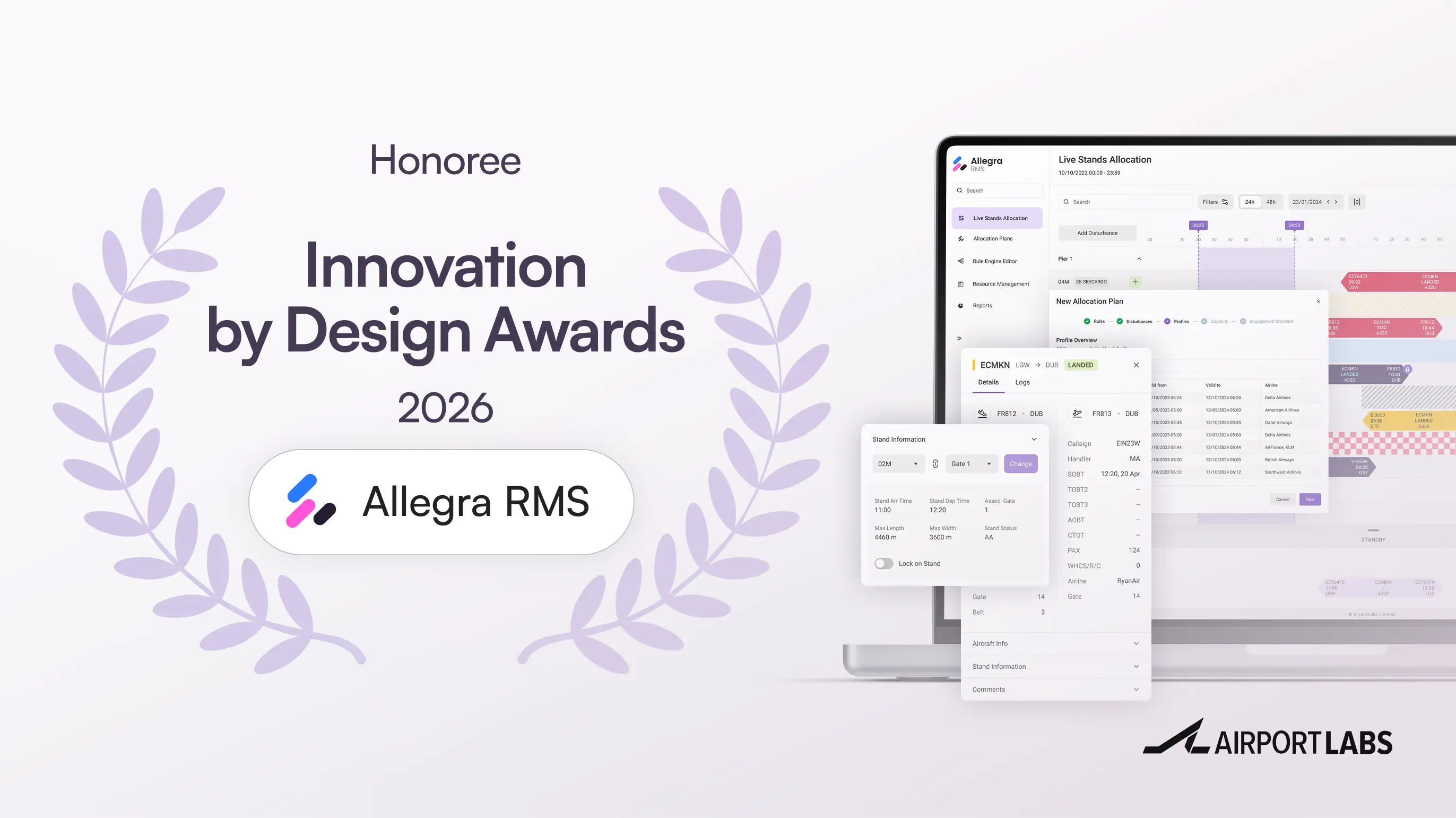
Allegra RMS is a next-generation Resource Management System designed to bridge the gap between operational planning and financial performance. Allegra acts as a dynamic optimisation engine. It utilises high-fidelity algorithms to synchronise the three pillars of airport profitability: Stand & Gate Management, Mobile Resource Allocation, and Seasonal Capacity Planning.
For the finance department, Allegra functions as an asset yield optimiser — ensuring every square metre of the airport is generating maximum revenue at all times.
Turning Operational Cost Reduction into Resource Profitability
Operational costs are often viewed as "fixed," but Allegra treats them as variables that can be tuned for profit. According to Deloitte’s 2026 Travel Industry Outlook, the deployment of AI-driven optimisation is now the primary differentiator between profitable hubs and those struggling with legacy debt.
1. Demand-Driven Labour Modelling
Ground handling and security staffing are among the highest variable costs. Allegra’s predictive algorithms align resource allocation with actual seasonal demand rather than static, historical schedules. By identifying precisely when and where staff are needed, airports can reduce overtime leakage and under-utilisation, addressing the labour shortages highlighted in recent EUROCONTROL network performance data.
2. Maximising Every Square Meter
An airport is a high-value built infrastructure. Allegra optimises the earning potential of every stand by prioritising gate assignments based on passenger flow metrics. It ensures that high-capacity aircraft are positioned to feed the highest-yielding duty-free and food & beverage zones, capitalising on the synergy between operational flow and commercial spend — a "hidden lever" of profitability often cited in Satair’s 2026 Market Insights.
From Software Cost to Revenue Maximisation
The primary concert with SaaS investments is often the time to value. Allegra RMS addresses this through Seasonal Profit Realisation. Allegra does not merely record the schedule — it stress-tests it.
- Advanced "What-If" Simulations: Before a new season begins, CFOs can use Allegra to run thousands of simulations. What happens if a major carrier adds a red-eye flight? What if ground handling strikes reduce capacity by 20%? Allegra identifies the financial breaking points of the schedule before they occur.
- Algorithmic Cost Avoidance: Traditional systems are reactive, leading to "Scenario A": a bottleneck occurs in July, and the airport pays premium rates for emergency staffing and suffers from delay-related penalties.
- Revenue Preservation: With Allegra ("Scenario B"), the system identifies the July bottleneck in March. It automatically suggests schedule adjustments and locks in resource allocations at standard rates, protecting the bottom line and preserving the $7.90 net profit per passenger projected for 2026.
The Bottom Line: SaaS ROI in Practice
In an era where ALG Global’s 2026 AI Trends identify "Agentic AI" as the primary tool for protecting margins, Allegra RMS stands out as a strategic financial asset.
It transforms the RMS from a cost of doing business into a tool for revenue maximisation. For the CFO, the investment in Allegra is not simply about better gate charts—it’s about ensuring that by the end of each season, operational efficiency has been successfully converted into measurable, tangible profit.
Ready to maximise your airport’s revenue potential? Book an Allegra RMS demo with the AirportLabs team today: https://www.airportlabs.com/other/get-in-touch
.png)